
Figures are not difficult to paint if you simplify the shape of a person into something we all recognise and can draw. Using a simple shape like a carrot, painting people into a landscape scene is easy. Paul Cezanne, the famous French impressionist, who first discovered the value of carrots in learning to draw and paint said, ‘The day is coming when a single carrot freshly observed will cause a revolution’.
On a piece of paper practice, with your rigger, drawing the outline shape of a carrot. Now fill it in. Paint a few carrots.
Next put a dot on top of some carrots - not too big, and leaving a small gap to represent the neck. Paint tiny darker carrots on the remaining carrot bodies, and what have we got ? Men and women!
If you spend half an hour painting carrot people you will find they start to grow arms and legs. What’s happening is you are starting to improvise and sketch, and the more you practice the better you will get at painting people.
Tuesday, 15 January 2008
Watercolour Painting - Painting People

Drawing Notes - Negative and Positive Spaces

Your ability to draw is greatly enhanced when you know how to identify positive and negative spaces, visually measure distances, and apply the resulting information to your drawings.
This lesson illustrates and demonstrates the process of breaking down subjects into positive and negative spaces, and sketching their shapes within a drawing space. The four parts are:
- Seeing lines between spaces
- Containing spaces in a drawing space
- From seeing spaces to sketching shapes
- Examining the final stages of a drawing.
Contour lines are formed when edges of spaces and/or objects meet. Contour lines can outline a complete object as well as its individual parts.
A contour drawing comprised of lines that follow the contours of the edges of various components of a subject and define the outline of its shapes.
Shapes are the outward contours or outlines of objects. Basic shapes include circles, ovals, squares or rectangles.
Positive space is the space in a drawing that is occupied by an object and/or its various parts.
Negative space refers to the background around and/or behind an object or another space.
Proportion refers to the relationship in size of one component of a drawing to another or others.
A drawing space (also called the drawing surface or a drawing format), refers to the area in which you render a drawing within a specific perimeter.
You can use the overall shape of your subject (and its parts) as a contour drawing in two steps:
- Study the subject until you can identify the subject’s positive space. Everything else is then considered negative space.
- Examine the shapes and sizes of the positive and negative spaces and how they fit together to identify the locations of the contour lines.
Sunday, 13 January 2008
Drawing Notes - Basic Techniques - Introduction
Most objects that we are likely to want to draw can be visually simplified into three basic shapes: cube, cone and sphere (plus any combination of these shapes).
Training yourself to see these shapes contained within your subjects makes it considerably easier for you to start to draw them, so it is worth practising. In addition, the whole idea of translating three-dimensional objects onto a two-dimensional surface can become easier by practising shading, looking carefully at where the highlights are on an object and at the corresponding shadows.
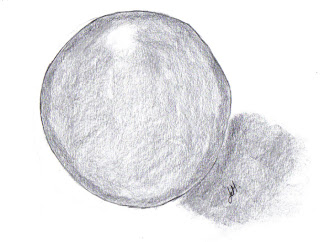
Spheres form the basis of many vegetables, such as onions and oranges, as well as vases, ornaments and even fish paraphernalia. The highlight here is usually circular and can normally be seen towards the top, where the natural light is reflected.

 The cube is the basis for objects as diverse as matchboxes, radios and garden sheds - only the scale differs. Unlike the two curved objects, a cube has clearly defined shading, usually light on top, medium tone on one side and a darker tone on the other visible side.
Studying light is also a valuable activity. Whilst writers and philosophers spend much time simply thinking, so artists spend much time just looking. The key is to mentally absorb what you see and be prepared to apply this to situations where you have to rely on your visual memory due to lack of appropriate lighting.
Finally, once you have mastered the skill of visualizing everyday objects as being constructed from individual spheres, cones and cubes, start to seek combinations to develop your own personal ‘toolbox’.
From Cone to Flowerpot
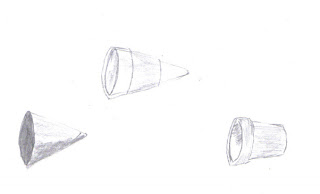
A cone can become the base shape for many objects, in this case, a flowerpot. Try to ensure that there are no points on the base: a smooth, unbroken line should curve round at the places where the straight lines meet in.
Next, start to construct the shape of the object that you wish to develop into a drawing around the base shape.
The base shape has now served its purpose and can be removed, leaving the ‘moulded’ shape of the flowerpot looking three-dimensional and thoroughly convincing.

